



Business
Profit Margin vs. Markup: How to Calculate Each and Price With Confidence
Learn the difference between profit margin and markup, calculate both from the same sale, convert between them, and price a product for a target gross margin.
# Profit Margin vs. Markup: How to Calculate Each and Price With Confidence
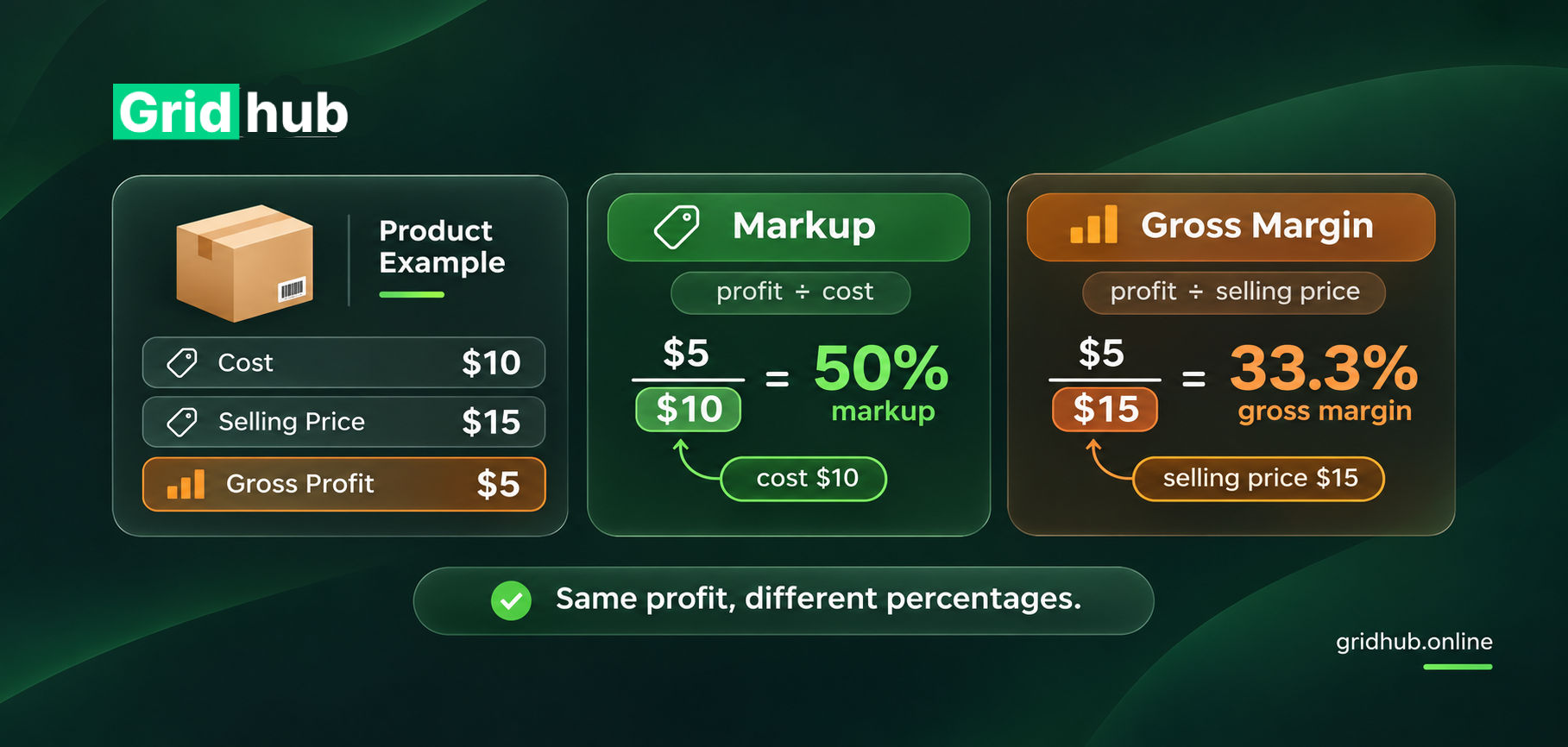
Profit margin and markup both describe the difference between what a product costs and what it sells for. They use different denominators, though, so the same sale can have a 50% markup and only a 33.3% gross profit margin. Mixing up the two can leave a price below your target.
Here is how to calculate each number, convert between them, and use a target margin to work backward to a selling price.
The difference in one example
Suppose a product costs $10 and sells for $15. The gross profit on that unit is $5 before overhead and other costs.
| Measure | What the percentage is based on | Calculation | Result |
|---|---|---|---|
| Markup | Unit cost | $5 ÷ $10 | 50% |
| Gross profit margin | Selling price (revenue) | $5 ÷ $15 | 33.3% |
The profit dollars are identical. Markup asks how much profit was added relative to cost; margin asks what share of the sale’s revenue remains after the direct product cost. Because the selling price is higher than cost on a profitable sale, markup will be higher than gross margin for that sale. Xero’s margin and markup guide and Business Queensland’s profit guide use these same bases.
The formulas
First calculate gross profit per unit:
```text
Gross profit = Selling price − Unit cost
`
Then calculate the ratios:
```text
Markup (%) = Gross profit ÷ Unit cost × 100
Gross profit margin (%) = Gross profit ÷ Selling price × 100
`
For the $10 product sold for $15:
```text
Markup = ($15 − $10) ÷ $10 × 100 = 50%
Gross profit margin = ($15 − $10) ÷ $15 × 100 = 33.3%
`
How to price for a target margin
If you know the unit cost and want a particular gross margin, divide the cost by the share of the price that will cover that cost:
```text
Price for target margin = Unit cost ÷ (1 − Target margin)
`
Write the margin as a decimal in the formula. For example, use 0.35 for 35%.
Say a product costs $24 and you want a 35% gross margin:
```text
$24 ÷ (1 − 0.35) = $24 ÷ 0.65 = $36.92
`
At a $36.92 price, gross profit is about $12.92. That is about 35% of the selling price. The markup is about 53.8% because the $12.92 profit is measured against the $24 cost.
This is why simply adding 35% to $24 does not produce a 35% margin. A 35% markup gives a price of $32.40 and a gross margin of about 25.9%.
The target-price formula follows the gross-margin calculation and is also shown in Mississippi State University Extension’s product-pricing guide. A target margin must be less than 100%; as it approaches 100%, the calculated price rises sharply.
How to convert between markup and margin
You can convert either ratio without recalculating from a dollar example:
```text
Margin = Markup ÷ (1 + Markup)
Markup = Margin ÷ (1 − Margin)
`
Enter each percentage as a decimal. A 50% markup becomes:
```text
0.50 ÷ (1 + 0.50) = 0.333… = 33.3% margin
`
And a 50% target margin requires:
```text
0.50 ÷ (1 − 0.50) = 1.00 = 100% markup
`
What costs belong in the calculation?
For a product’s gross margin, use a consistent unit cost that reflects the direct costs of making or acquiring that product. Depending on the business, this may include materials or purchase cost, production labor, and packaging. Mississippi State University Extension distinguishes these variable production costs from fixed overhead such as rent and insurance; gross margin helps show how much sales dollars remain to cover overhead and profit.
Do not assume that gross margin is the same as net profit. Operating expenses, payroll, taxes, financing costs, and other overhead may still need to be paid. Business Queensland’s formulas distinguish gross profit from net profit after operating expenses. To see whether a product price can support the whole business, combine margin analysis with fixed costs and a sales-volume estimate. The U.S. Small Business Administration’s break-even calculator uses fixed costs, unit price, and variable cost to estimate the units needed to break even.
For services, use an appropriate cost base for the work, such as direct labor and materials. Some businesses may find an hourly, value-based, or market-based pricing method more useful than product markup alone. The Australian Government’s pricing strategy guide recommends considering total costs, customer value, market research, and competitor prices when setting prices.
When should you use each number?
- Use markup when building a cost-plus price: it tells you how much to add to the unit cost.
- Use gross margin when reviewing product profitability: it tells you what share of revenue remains after the direct product cost.
- Use net margin when you want to understand profit after the relevant operating expenses have also been included.
Neither markup nor gross margin picks the right price on its own. A price also needs to make sense for customers and the market. Check what buyers value, compare relevant alternatives, and revisit the calculation when costs or selling conditions change. business.gov.au’s pricing guidance covers these checks alongside cost-based pricing.
Three pricing mistakes to avoid
- Calling markup “margin.” State which percentage you mean whenever you discuss a price with a supplier, business partner, or team member.
- Treating gross margin as take-home profit. Gross margin has not necessarily paid the business’s rent, payroll, or other overhead.
- Forgetting what the unit cost includes. If a direct cost is left out, the percentage can look healthy while the dollars available to cover the rest of the business are lower than expected.
Before you set the price, calculate both ratios, verify the unit cost, and test whether the resulting price works for your customers and your sales plan.
Try the numbers
Use GridHub’s free Profit Margin Calculator to compare unit profit, gross margin, markup, and a price for your target margin. When you are ready to track real products and sales, continue in the Sales & Revenue tool.
*This guide explains basic pricing arithmetic. It does not set a universal target margin or replace advice based on your accounting method, market, or business costs.*
This guide is general information for educational purposes. Verify details that depend on your personal circumstances, jurisdiction, or current product terms.
Keep going with GridHub
Put this guide into practice
Use a relevant GridHub tool to put these ideas into action.