



Money
How to Budget With Irregular Income: A Practical Plan for Low and High Months
Build a flexible budget for freelance, seasonal, commission, or gig income by separating received money from forecasts, protecting essential bills, and planning how to use stronger months.
# How to Budget With Irregular Income: A Practical Plan for Low and High Months
When your pay changes from month to month, a budget based on one “normal” paycheck can break as soon as a slow week or delayed invoice arrives. A more useful plan separates money you have received from money you expect, protects essential bills first, and gives higher-income months a job before the extra gets spent.
This guide is for freelancers, contractors, commission earners, seasonal workers, gig workers, and anyone whose take-home income moves around. The steps work with a notebook or spreadsheet; a budget planner can also help you compare income and planned expenses month by month.
Start with what actually arrived
Gather recent pay statements, invoices, deposit records, or transaction history. Six to twelve months can reveal seasonal patterns; if you have less history, use what you have and revisit the estimate as new months come in. Record take-home income after payroll deductions. If you are self-employed, keep tax money separate from spendable take-home income and check the rules that apply where you live.
Make a simple month-by-month list:
| Month | Income received | Essential bills | Other planned spending | Difference |
|---|---|---|---|---|
| January | ||||
| February | ||||
| March |
Look at more than the average. Note your lowest month, your typical month, the dates income tends to arrive, and any predictable busy or quiet seasons. An average can describe the year while hiding a cash shortfall in a particular week. Federal Reserve survey results underline that month-to-month variation is common: in its 2025 U.S. household survey, 30% of adults said income varied at least occasionally during the year. That is context, not a forecast for your household.
Find your essential monthly floor
List the bills and costs that keep your household safe and functioning: housing, utilities, basic food, transportation, insurance, medication, childcare, and required minimum debt payments. Add amounts that arrive less often, such as annual insurance or vehicle registration, by estimating a monthly set-aside for each. Check bills and due dates so you are budgeting for the actual timing as well as the total.
Then compare this essential floor with the income you can reasonably count on. Avoid building required spending around your best month. If the floor is higher than your reliable income, that is useful information: mark the gap clearly, review flexible costs, and consider contacting providers early about available payment arrangements or assistance. A spreadsheet cannot create income or guarantee every bill can be paid.
Choose a cautious baseline, then adjust
There is no single baseline that fits every income pattern. One option is to plan essential spending around a conservative estimate, such as a lower recent month that still reflects your current work. If your income is strongly seasonal, use a longer view and account for the season rather than treating an unusually quiet month as normal all year. Penn State Extension describes using the lowest month from the past six months or the six-month average as possible estimates; compare both with your own seasonality and obligations before choosing.
Keep the estimate explicit. For example, write “baseline: $2,800 take-home; review after three months” instead of treating the number as guaranteed. Recalculate when a contract ends, hours change, or your season changes.
Give each payment an order of jobs
When money arrives, use a consistent order so a strong week does not accidentally leave next week’s rent unfunded:
- Set aside required taxes first if they are not withheld. The amount and payment schedule depend on your country, tax situation, and work status. In the United States, the IRS says independent contractors may need to make estimated tax payments; see current IRS guidance or a tax professional for your circumstances.
- Cover essentials and bills due before the next expected income. Use due dates and available cash, not just monthly totals.
- Replenish a cash-flow buffer. This is money reserved to bridge timing gaps between income and bills. Decide a practical initial target based on your next bill cycle, then build gradually if possible.
- Fund flexible spending and goals. Set these amounts after the first three jobs are covered.
If your income is too low to cover every job, prioritize immediate necessities, understand the consequences and options for each bill, and contact creditors or service providers early. Rules and assistance programs vary by location.
Use high-income months to smooth low ones
Decide in advance what extra income will do. After taxes and upcoming essentials, you might direct a chosen share toward the buffer, irregular annual expenses, debt goals, or longer-term savings. The split is personal; there is no universal percentage that works for every household.
Suppose your take-home income is $2,400 in a quiet month and $4,200 in a stronger month, while essential bills total $2,700. In the quiet month, the plan shows a $300 gap before flexible spending. In the stronger month, the $1,500 above essentials can help refill the buffer and prepare for the next quiet month. These are illustrative figures, not a recommended target. Track the reserve separately so you can tell what is available for regular spending.
Plan for timing, not only totals
A month can look balanced on paper and still run short if bills are due before a late client payment. Create a calendar with expected deposit dates and bill due dates for the next four to six weeks. Mark income as received or expected; do not spend expected money as if it has cleared. If a bill date regularly falls before income arrives, ask the provider whether another due date is available, and keep the timing gap visible in your plan.
The CFPB’s cash-flow budgeting materials emphasize tracking when income and expenses occur. That view can reveal a shortfall that a static monthly budget hides. If your pay frequency is weekly or irregular, a weekly or payday review may be more useful than checking only at month-end.
Review once a week and reset monthly
Choose a short, repeatable check-in. Update income received, upcoming bills, and the buffer balance. At month-end, compare planned and actual amounts, then adjust the next plan without treating a missed estimate as a personal failure. Look for patterns: late invoices, a recurring expensive week, seasonal dips, or bills clustered together.
The goal is not to predict every payment perfectly. It is to notice changes early and make a plan with the money and dates you can verify.
A quick checklist
- Record take-home money that has actually arrived.
- Review several months of history and mark seasonality.
- Add up essential expenses and their due dates.
- Pick a conservative baseline and schedule when you will review it.
- Set aside taxes when applicable and confirm local requirements.
- Fund essentials due before the next expected payment.
- Build a buffer gradually and assign stronger-month income ahead of time.
- Reconcile actuals against the plan every week or payday.
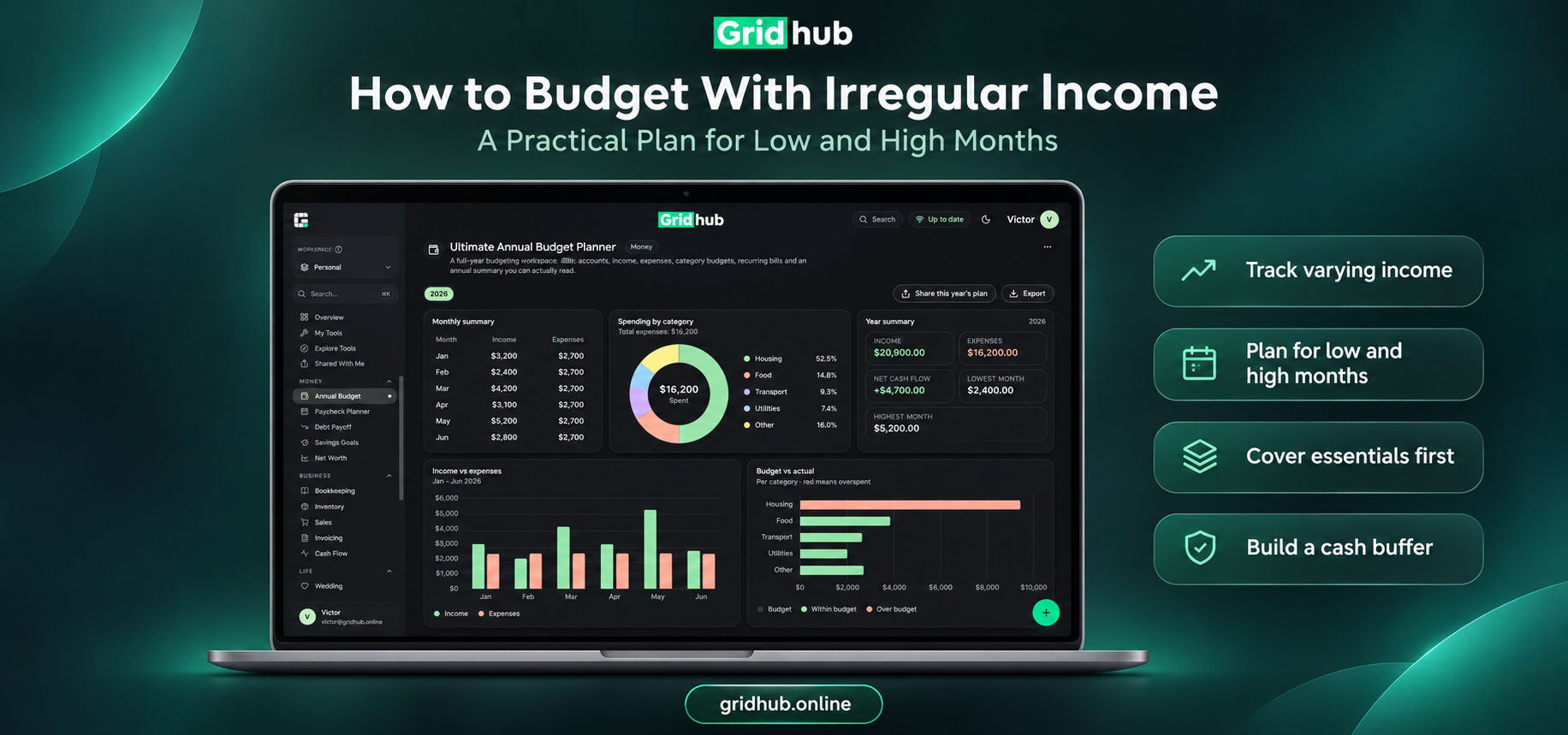
GridHub’s Annual Budget Planner can help organize income, planned expenses, category budgets, and recurring bills. Use it to compare a cautious baseline with actual monthly results; keep expected income distinguishable from money already received.
*This article is general educational information, not individualized financial, tax, legal, or credit advice. Tax rules differ by jurisdiction and personal circumstances; verify current requirements with the relevant tax authority or a qualified professional.*
Sources
- Federal Reserve Board, Report on the Economic Well-Being of U.S. Households in 2025: Income and Expenses. Survey fielded in October 2025; report published May 13, 2026.
- Consumer Financial Protection Bureau, Your Money, Your Goals toolkit, including the income tracker and cash-flow budgeting guidance.
- Penn State Extension, Budgeting with Irregular Income. Published April 22, 2025.
- Internal Revenue Service, Manage taxes for your gig work. U.S. tax guidance; check the current page for updates.
This guide is general information for educational purposes. Verify details that depend on your personal circumstances, jurisdiction, or current product terms.
Keep going with GridHub
Put this guide into practice
Use a relevant GridHub tool to put these ideas into action.
Related guides
Money
How to Estimate Your Debt Payoff Time
Estimate when a debt could be paid off using its balance, APR, and payment. Compare fixed-payment scenarios, snowball and avalanche plans, and the lender terms that can change the result.

Money
Debt Snowball vs. Avalanche: How to Choose a Payoff Strategy
Compare the debt snowball and avalanche methods, decide where extra payments go, and build a payoff plan you can keep following.