



Money
How to Estimate Your Debt Payoff Time
Estimate when a debt could be paid off using its balance, APR, and payment. Compare fixed-payment scenarios, snowball and avalanche plans, and the lender terms that can change the result.
# How to Estimate Your Debt Payoff Time
Knowing your current balance is useful, but it does not tell you when the debt will be gone. Your payoff estimate also depends on the interest rate, how much you pay, how the lender applies payments, and whether the balance changes while you repay it.
This guide shows how to make a practical estimate, compare payment amounts, and understand why a calculator result may differ from a lender’s statement. It is educational information, not a payoff quote or individualized financial advice.
Gather the numbers from your latest statement
For each account, write down:
- Current balance
- Annual percentage rate (APR), including any separate rates for purchases, transfers, or cash advances
- Required minimum payment
- Payment due date
- Any promotional rate end date, deferred-interest deadline, or fee that could affect the balance
Use the statement or lender account for current figures. If you are planning to close an account or pay it off in full, ask the lender for a payoff quote; the amount can include interest through the date the payment reaches them.
For multiple debts, list each account separately. One combined balance hides which rates are driving the cost and which payment is due next.
Understand the basic monthly estimate
For a simple fixed-rate estimate with monthly payments, a calculator can use this sequence:
- Start with the opening balance.
- Estimate that month’s interest as opening balance × APR ÷ 12. For example, 18% APR is 1.5% per month in this simplified model.
- Add the interest to the balance.
- Subtract the payment, without allowing the balance to fall below zero.
- Repeat until the remaining balance reaches zero.
The payment needs to be greater than the interest being added for the balance to shrink. If a $4,000 balance accrues about $60 in monthly interest under this example, a $50 payment would not reduce it under the model. Your lender’s actual interest and payment allocation may differ, so check your statement and account terms.
Compare payment amounts using the same assumptions
Here is an illustration for a $4,000 balance at 18% APR with no new charges or fees. It assumes interest is added monthly at APR divided by 12, interest is rounded to cents, and the same payment is made every month. The final payment is capped at the amount still owed.
| Fixed monthly payment | Estimated payoff time | Estimated interest |
|---|---|---|
| $150 | 35 months | $1,146.68 |
| $200 | 24 months | $791.31 |
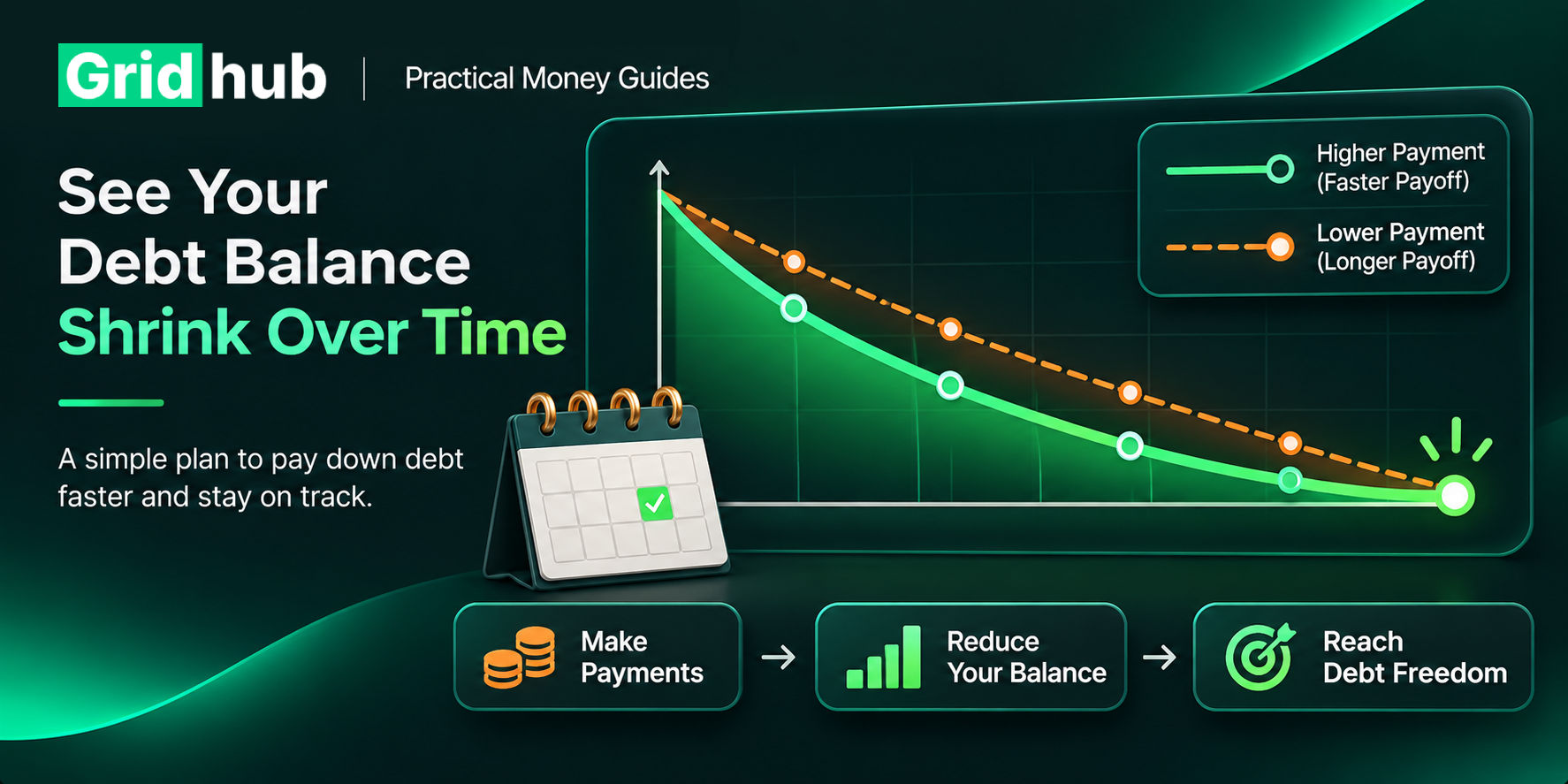
In this simplified example, the $50 higher monthly payment clears the balance about 11 months sooner and reduces modeled interest by about $355.37. It is an illustration of the calculation, not a promise of savings. A real card may use a daily balance method, apply a changing minimum payment, add purchases or fees, or use multiple APRs.
Try a payment that fits your actual budget, then compare another amount you could sustain. Keep required minimums current on every account before assigning additional money.
If you have several debts, include payment order
For a portfolio of debts, the time to clear every account depends on both the total amount you can pay and the order in which extra money is applied.
- Snowball: pay required minimums, then direct the extra amount to the smallest balance. After it is paid, roll its payment into the next target.
- Avalanche: pay required minimums, then direct the extra amount to the highest APR. After it is paid, roll its payment into the next target.
The avalanche prioritizes higher-rate balances. The snowball prioritizes an earlier small-balance milestone. Neither strategy removes the need to pay minimums on the other accounts. In the U.S., credit-card issuers generally must apply the amount above the required minimum to the highest-APR balance first, with special rules for deferred-interest balances. Review your card agreement and statement for how your own account is handled.
GridHub’s Debt Payoff Calculator compares snowball and avalanche projections using your debts, minimum payments, and planned extra amount. The Debt Payoff Tracker can keep the records and projected schedules together as your balances change.
Check what “extra payment” means to your lender
An extra payment only improves the estimate as expected if it reduces the balance in the way the calculation assumes. Before sending a lump sum or recurring extra amount, check:
- Whether the lender applies the extra to principal or credits it toward a future scheduled payment
- Whether you need to select a “principal only” option or contact the servicer
- Whether a prepayment fee, promotional APR, or deferred-interest deadline changes the tradeoff
- How payments are divided when different rates apply to balances on one account
For example, the CFPB notes that student-loan servicers may place extra money in “paid ahead” status instead of reducing principal as the borrower expects; borrowers can ask how to direct the payment. Credit-card payment allocation also follows specific rules when rates differ. Check the terms for your account before relying on a projection.
Know why the real payoff date can differ
A projection is an estimate based on inputs and assumptions. The actual date and total cost can change when:
- The APR changes or a promotional rate ends
- The required minimum payment changes as the balance falls
- New transactions, late fees, or other charges are added
- Interest accrues daily or payment dates differ from the calculator’s monthly timing
- A payment is late, returned, or applied to a different balance than expected
- The lender treats an extra payment as a future installment rather than an additional principal reduction
Use the estimate to compare scenarios, then check your account statement regularly. If the minimum payment is not reducing the balance, contact the lender about the account terms and available options.
A practical payoff-estimate checklist
- Confirm each balance, APR, minimum, and due date from the latest statement.
- Separate accounts and any different APR balances.
- Choose a total monthly amount that you can maintain after essential expenses.
- Compare the payoff time and interest with minimums plus a realistic extra amount.
- For multiple debts, compare snowball and avalanche using the same payment budget.
- Confirm with each lender how extra payments are applied and whether any special terms apply.
- Recalculate after a rate change, new charge, fee, or payoff.
The number is a planning aid. Your lender’s payoff quote and account terms govern the amount needed to close an account.
Sources
- Consumer Financial Protection Bureau, What does the three-year payoff box on my credit-card bill mean?.
- Consumer Financial Protection Bureau, How is my student loan payment applied to my account?.
- Consumer Financial Protection Bureau, Regulation Z § 1026.53: Allocation of payments.
- Consumer Financial Protection Bureau, How does my credit-card company calculate the amount of interest I owe?.
- Consumer Financial Protection Bureau, Can I pay off my student loan in full at any time?.
*This article provides general educational information, not individualized financial, legal, or credit advice. Product terms and consumer-protection rules vary by account and jurisdiction. Confirm current terms with your lender and local regulator.*
This guide is general information for educational purposes. Verify details that depend on your personal circumstances, jurisdiction, or current product terms.
Keep going with GridHub
Put this guide into practice
Use a relevant GridHub tool to put these ideas into action.
Related guides

Money
How to Budget With Irregular Income: A Practical Plan for Low and High Months
Build a flexible budget for freelance, seasonal, commission, or gig income by separating received money from forecasts, protecting essential bills, and planning how to use stronger months.

Money
Debt Snowball vs. Avalanche: How to Choose a Payoff Strategy
Compare the debt snowball and avalanche methods, decide where extra payments go, and build a payoff plan you can keep following.